The Productive Void: How Embracing Ignorance Became the Secret Engine of Genius

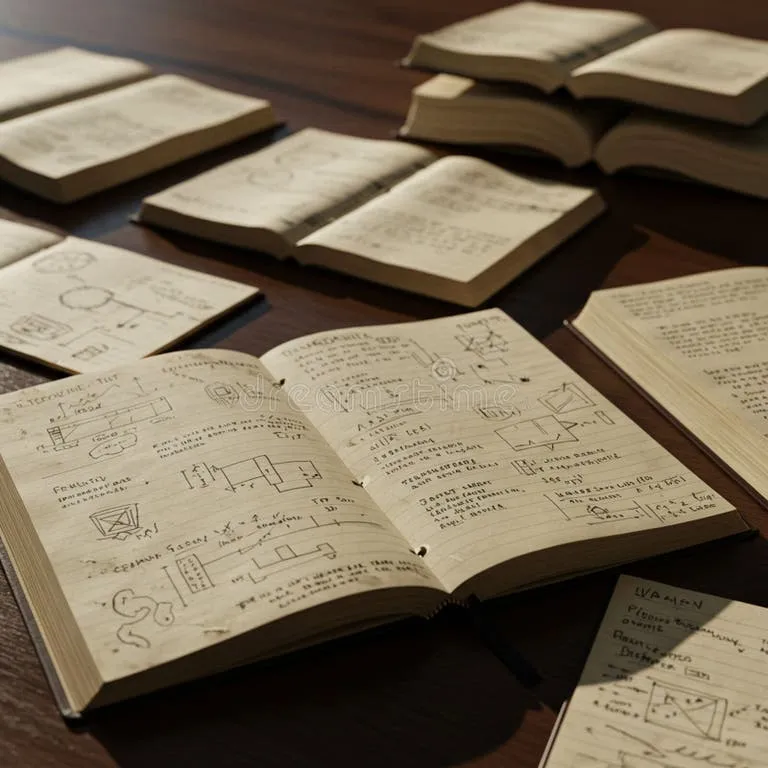
Photo: scientist artist notebook open question contemplation uncertainty, via www.osnabrueck-net.de
There is a particular kind of confidence that masquerades as knowledge. It fills conference rooms, dominates cable news panels, and populates the comment sections of every professional forum on the internet. It speaks in declarative sentences, cites credentials, and treats ambiguity as a public relations problem to be managed rather than a philosophical condition to be inhabited. It is, in nearly every case, the enemy of original thought.
The great irony of intellectual history is that the figures we most celebrate for their knowledge were, in their most productive moments, most acutely aware of what they did not know. This is not a paradox. It is a pattern — one that connects the physicist scrawling equations on a napkin in Pasadena to the painter staring at a canvas in lower Manhattan, both suspended in the same productive uncertainty, both doing the same essential work.
Feynman's Gift for Not Knowing
Richard Feynman is remembered as one of the most brilliant physicists of the twentieth century. What is less frequently celebrated is that he was also among the most disciplined practitioners of acknowledged ignorance in the history of American science. His lectures at Caltech were famous not merely for their clarity but for the frequency with which he paused to say, in some form or another, that he genuinely did not understand something — and that this failure of understanding was precisely where the interesting work began.
In a 1981 BBC interview, Feynman articulated what might be the most underappreciated principle in scientific methodology: "I can live with doubt and uncertainty and not knowing. I think it's much more interesting to live not knowing than to have answers which might be wrong." This was not false modesty. It was a methodological commitment. Feynman understood that the premature closure of a question — the rush to a satisfying explanation — was the greatest threat to genuine understanding. His Nobel Prize-winning work on quantum electrodynamics emerged not from certainty but from a sustained willingness to remain confused until the confusion itself revealed its structure.
This orientation toward productive not-knowing has a name in contemporary psychology: epistemic humility. Researchers studying expert performance have found that the most effective scientists are distinguished not by the confidence of their conclusions but by their acute sensitivity to the boundaries of their knowledge — what they can claim, what they suspect, and what remains genuinely open. The expert who cannot locate the edge of their own expertise is, paradoxically, the least reliable guide.
Rothko's Unfinished Argument
Mark Rothko never explained his paintings. This was not evasiveness. It was principle. When pressed by critics and collectors to decode the emotional registers of his luminous color fields — those hovering rectangles of crimson and black, ochre and violet — he refused with a consistency that bordered on the ferocious. "Silence is so accurate," he once remarked, a statement that functions simultaneously as aesthetic philosophy and epistemological position.
Rothko's refusal to resolve his own work — to provide the interpretive key that would allow a viewer to consume a canvas rather than experience it — was a form of intellectual humility rendered in paint. He understood that the moment he fixed the meaning of a work, he diminished it. The uncertainty was not incidental to the art; it was the art. His canvases do not answer questions about emotional experience. They ask them, and they ask them in a register that resists verbal translation by design.
This is not so different from Feynman's position. Both men operated in domains where the temptation to produce a finished, legible product — a clean theory, a decoded painting — was enormous. Both resisted that temptation on the grounds that premature resolution falsifies the underlying reality. The physicist and the painter were, in this sense, engaged in the same epistemological project: keeping the question alive.
The Expertise Economy's Dangerous Bargain
The contemporary American professional landscape has constructed an elaborate apparatus for rewarding certainty. Consultants are paid to have answers. Thought leaders are expected to project conviction. The TED Talk format — with its compressed arc from problem to epiphany — has become the dominant grammar of public intellectual life, and it is a grammar that structurally excludes uncertainty. There is no TED Talk entitled "Here Is What I Genuinely Don't Understand Yet."
This creates a cultural environment in which the performance of knowledge crowds out the actual acquisition of it. Researchers studying organizational behavior have documented what they call "the expertise trap": the tendency of domain experts, as their status increases, to become progressively less open to information that challenges their existing frameworks. The more credentialed the expert, the research suggests, the more psychologically costly it becomes to say "I was wrong" or "I don't know" — and the more likely they are to avoid situations that might require them to.
The consequences extend well beyond professional embarrassment. In science, the expertise trap produces paradigm stagnation — the decades-long persistence of explanatory frameworks that have outlived their usefulness because no one with sufficient standing is willing to acknowledge their inadequacy. In art, it produces the equally dispiriting phenomenon of the artist who has found a successful formula and mines it indefinitely, mistaking commercial legibility for creative vitality.
The Discipline of the Open Question
What distinguished Feynman and Rothko — and what connects them to a broader tradition that includes Darwin's genuine bewilderment at the mechanisms of inheritance, Georgia O'Keeffe's lifelong refusal to settle on a fixed relationship between representation and abstraction, and Einstein's famous acknowledgment that the more he learned, the more mysterious the universe became — was not merely their tolerance for uncertainty but their active cultivation of it.
This is a crucial distinction. Passive uncertainty is simply ignorance. Active uncertainty — the kind that Feynman and Rothko practiced — is a disciplined orientation toward the unknown that keeps perception fresh, prevents premature closure, and creates the cognitive space in which genuinely new ideas can form. It requires, paradoxically, a kind of confidence: the confidence that not knowing is a legitimate and even productive state, rather than a deficiency to be concealed.
For scientists, this might mean resisting the pressure to publish before a result is truly understood, or acknowledging in print the anomalies that a theory cannot yet explain. For artists, it might mean refusing to repeat a successful gesture simply because the market has rewarded it, or leaving a work in a state of productive irresolution rather than forcing it to a tidy conclusion.
What Genius Actually Looks Like
We have constructed a mythology of genius that emphasizes arrival — the eureka moment, the masterwork, the definitive theory. What the historical record actually shows is something considerably less dramatic and considerably more instructive: a sustained practice of staying lost, of remaining genuinely uncertain, of treating every answer as the beginning of a better question.
The scientists and artists who have most enlarged our understanding of the world share this quality above all others. They were not the most confident people in their fields. They were the most honestly confused — and they had the discipline, and the courage, to stay that way long enough for something true to emerge.
In an age that has monetized certainty and pathologized doubt, this may be the most radical thing a thinking person can do: admit, with precision and without apology, exactly where their knowledge ends. That boundary is not a wall. It is a door.