In the Margins of the Magnificent: The Hidden Art Lives of Scientific Notebooks
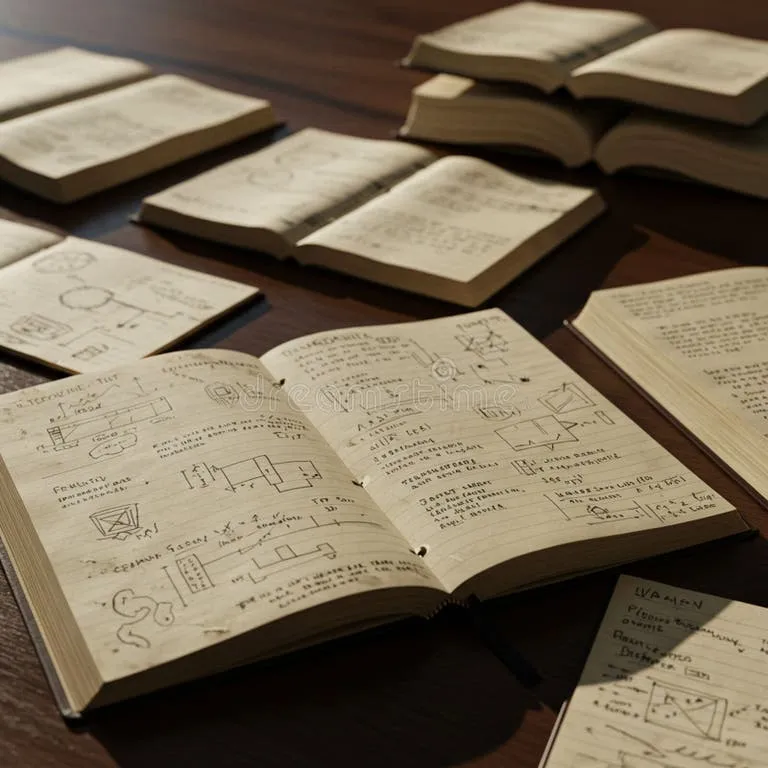
Photo: vintage scientific notebook open with sketches doodles handwritten notes close up, via thumbs.dreamstime.com
Charles Darwin drew a tree. It was 1837, and he was working through a problem that had no established vocabulary yet — the problem of how species relate to one another across time, how lineages diverge and branch and occasionally terminate. He needed to think, and thinking, for Darwin, apparently required a pencil and a page. The result was a rough, branching diagram with the words "I think" written above it in his cramped hand — a phrase that reads now less like a qualifier than like a caption for the act of visual cognition itself.
The sketch was not published. It was not intended to be. It occupied a corner of a notebook that also contained grocery lists, observations about barnacles, and calculations that went nowhere. It was, by any conventional measure, marginal. And yet it is one of the most consequential drawings in the history of science — not because it solved the problem of common descent (it did not, quite), but because it made the problem visible in a way that language alone could not.
The Notebook as Laboratory
Scientific notebooks have always been, in their essential nature, hybrid objects. They are not finished products but active processes — the site where observation encounters hypothesis, where calculation meets intuition, where the pressure of a difficult problem produces responses that do not always fit the categories of either art or science.
The great scientific archives of the world — the Darwin papers at Cambridge, the Feynman archives at Caltech, the Leonardo manuscripts scattered across European libraries, the Einstein papers at the Hebrew University of Jerusalem — contain, between their more celebrated pages, an extraordinary accumulation of visual material that has received comparatively little serious attention. Doodles, diagrams, sketches, cartoons, decorative borders, portraits of colleagues, and abstract mark-making of no apparent instrumental purpose fill the margins of documents that have otherwise been studied with intense scrutiny.
Historians of science have tended to treat this material as incidental — the residue of restless hands during moments of distraction. This is almost certainly wrong. A growing body of research in cognitive psychology and the history of ideas suggests that these visual margins are not the byproduct of scientific thinking but a constituent part of it — a mode of cognition that the formal record of science, with its preference for the linear and the verbal, systematically obscures.
Feynman's Diagrams and the Art of Thinking Visually
The case of Richard Feynman offers the most publicly legible example of this phenomenon. The diagrams that bear his name — the elegant, schematic representations of particle interactions that he developed in the late 1940s — began as private visual shorthand, a way of keeping track of computational relationships that were too complex to hold in the mind through symbolic algebra alone.
Feynman himself was explicit about the cognitive role these drawings played. They were not illustrations of calculations he had already performed; they were tools for performing the calculations — a form of visual thinking that preceded and enabled the mathematical formalization. The diagram was the thought, or at least an essential part of it, before it became a notation system adopted by physicists worldwide.
What is less often discussed is the broader visual culture of Feynman's notebooks and correspondence. He drew constantly — portraits, landscapes, figures, abstract patterns — and regarded this drawing practice as continuous with, rather than separate from, his scientific work. He studied art formally, exhibited work under a pseudonym, and spoke in interviews about the way visual attention sharpened his perception of physical phenomena. The physicist and the draftsman were, for Feynman, the same person engaged in the same fundamental activity: looking carefully at something until it revealed its structure.
Darwin's Branching Thought
The "I think" tree is the most famous of Darwin's visual marginalia, but it is far from the only significant example. His notebooks are threaded with quick sketches — of specimens, of geographical formations, of the faces of people he encountered on the Beagle voyage — that function as a kind of parallel record of his developing thought, one that runs alongside the verbal text without being reducible to it.
Biographers and historians of science who have worked closely with the Darwin papers report a consistent finding: the visual material is not decorative. It marks moments of genuine cognitive difficulty, points in the argument where the verbal-symbolic mode of reasoning has reached its limit and the mind reaches for a different tool. The sketch is not an illustration of an idea that already exists. It is part of the process by which the idea comes to exist.
This observation has significant implications for how we understand scientific creativity. The standard narrative of scientific discovery emphasizes the logical — the hypothesis, the experiment, the conclusion. What the notebooks reveal is something messier and more interesting: a process in which visual, spatial, and imaginative thinking play essential roles that the formal account of science is poorly equipped to describe.
The Leonardo Problem
No discussion of scientific doodling can avoid Leonardo da Vinci, though his case is in some respects too extreme to be fully representative. Leonardo's notebooks are so thoroughly integrated in their visual and scientific content — anatomical drawings that are simultaneously works of art, engineering sketches that function as aesthetic objects, marginal figures that bleed into technical diagrams — that the distinction between drawing and thinking effectively collapses.
But this is precisely what makes Leonardo instructive. He represents, in an unusually pure form, a mode of intellectual engagement in which the separation between artistic and scientific thinking was not yet fully institutionalized. He drew because he thought that way — because visual representation was not a secondary translation of ideas formed in words or numbers but a primary mode of inquiry with its own logic and its own capacity for discovery.
The subsequent centuries of disciplinary specialization — the gradual separation of art and science into distinct professional cultures with distinct methods, vocabularies, and institutional homes — did not eliminate this mode of thinking. It merely drove it to the margins. Literally.
What the Doodle Knows
Recent research in cognitive psychology has begun to produce empirical support for what the notebooks have always suggested. Studies examining the relationship between drawing and memory, between sketching and problem-solving, and between visual representation and conceptual development consistently find that the act of drawing — even drawing that is not directed toward any specific communicative purpose — produces measurable cognitive benefits.
Jackie Andrade's widely cited 2009 study found that participants who doodled during a monotonous listening task retained 29 percent more information than those who did not — a finding that has been replicated and extended in subsequent work. Researchers studying design practice have found that sketching during the early stages of problem-solving produces more creative solutions than verbal or purely analytical approaches. The hand, it seems, knows things the prefrontal cortex is still working out.
This is not, of course, what the doodle looks like from the outside. From the outside, it looks like distraction, like idleness, like the failure to pay proper attention. The history of science suggests otherwise. The margins of the great scientific notebooks are full of evidence that the most rigorous thinkers in history regularly escaped into visual play — and returned from those escapes with something they could not have found by staying on the main road.
Reclaiming the Margin
The artificial boundary between serious scientific work and artistic expression is, in the end, a bureaucratic convenience rather than a description of how thinking actually operates. The notebooks know this. Darwin's tree knew it. Feynman's diagrams knew it. The long tradition of visual marginalia in the history of science is, among other things, a continuous quiet argument against the compartmentalization of human intelligence.
In an era of increasing specialization — when the pressure to produce legible, publishable, fundable work has never been greater — the doodle in the margin represents something worth defending: the space where the mind plays without obligation, where the hand moves before the argument is formed, where the next idea is being drawn before anyone knows what it is.
That space, it turns out, is not peripheral to the work. It may be where the work actually begins.