When Systems Break Open: The Hidden Chaos Behind Every Artistic and Scientific Revolution
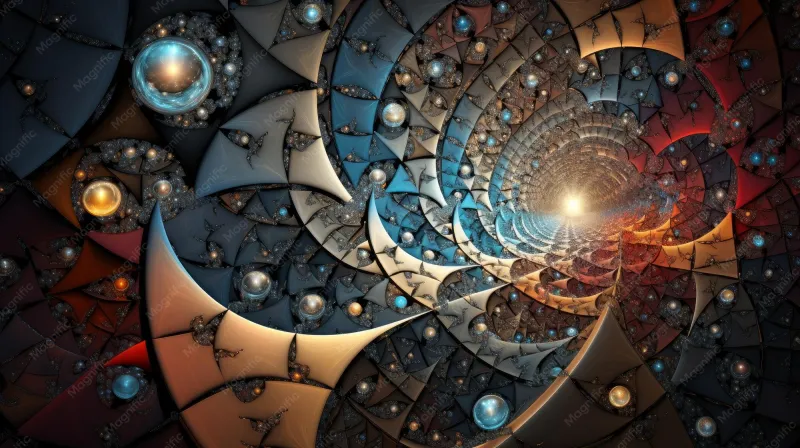
Photo: chaos theory abstract visualization scientific revolution art mathematics, via img.freepik.com
In the spring of 1905, a twenty-six-year-old patent clerk in Bern, Switzerland published four papers that collectively dismantled the Newtonian framework that had governed physics for more than two centuries. That same decade, a young Spaniard in Paris was quietly assembling a canvas that would shatter four hundred years of pictorial convention. Neither Albert Einstein nor Pablo Picasso announced their revolutions in advance. Neither emerged from a vacuum. And neither, despite the mythology of lone genius, was operating in isolation from the turbulent intellectual systems that surrounded them.
The proximity of these two upheavals—one scientific, one artistic—has long tempted historians to find a causal connection. The more illuminating question, however, is not whether Einstein influenced Cubism or vice versa, but why both eruptions happened when they did, and what their timing reveals about the nature of creative transformation itself.
The Myth of Linear Progress
The standard narrative of intellectual history is one of gradual accumulation. Scientists build upon scientists; artists absorb and extend their predecessors. Progress, in this telling, is a ramp: slow, steady, and directional. It is a comforting story, and it is largely false.
The historian of science Thomas Kuhn disrupted this narrative in 1962 with The Structure of Scientific Revolutions, arguing that science does not advance continuously but through periodic, violent ruptures he called paradigm shifts. Normal science, Kuhn observed, is essentially conservative—a disciplined effort to solve puzzles within an accepted framework. But anomalies accumulate. Contradictions multiply. And at some threshold of internal tension, the framework does not bend; it breaks, giving way to an entirely new conceptual order.
What Kuhn described in the language of philosophy, complexity science has since reframed in the language of mathematics. The behavior he observed in scientific communities is structurally identical to what physicists call a phase transition—the moment when water becomes ice, or a magnetized material suddenly aligns its domains. The system appears stable until, at a critical threshold, it reorganizes entirely and instantaneously.
Chaos as Creative Condition
Chaos theory, developed through the latter half of the twentieth century by researchers including Edward Lorenz, Ilya Prigogine, and Mitchell Feigenbaum, offers a complementary lens. Complex systems—whether atmospheric, biological, or cultural—do not fail gracefully. They operate in states of dynamic tension, perpetually balanced between order and disorder, until a perturbation of sufficient magnitude triggers what complexity theorists call bifurcation: a sudden branching into a new regime of behavior.
The artistic parallel is striking. Consider the decades immediately preceding the Impressionist eruption of the 1870s. French academic painting had reached a condition of extraordinary technical refinement and extraordinary imaginative exhaustion simultaneously. The Salon system rewarded mastery of established conventions; the conventions had become so thoroughly codified that deviation was effectively prohibited. The system had maximized its internal order—and in doing so, had become brittle.
When Monet, Renoir, Pissarro, and their contemporaries began exhibiting independently in 1874, they were not simply proposing a new style. They were releasing pressure that had been building within a system approaching criticality. The movement that followed was not linear development but phase transition: within a single generation, the entire axis of Western painting reoriented.
Parallel Explosions: A Pattern, Not a Coincidence
The pattern repeats with remarkable consistency across both domains. The quantum revolution of the 1920s—Heisenberg's uncertainty principle, Schrödinger's wave mechanics, Bohr's complementarity—arrived not as a single insight but as a cascade, with multiple researchers independently reaching similar conclusions within years of one another. This is precisely the signature of a system at critical threshold: the breakthrough is not owned by any individual but released by the collective conditions.
The same structure is visible in the emergence of Abstract Expressionism in postwar New York. Pollock, de Kooning, Rothko, and Kline did not coordinate their departures from figuration; they responded, independently and near-simultaneously, to a cultural moment that had made the old pictorial languages inadequate. The trauma of World War II, the anxiety of the atomic age, the displacement of the European avant-garde to American shores—these were the perturbations that pushed a system already under tension past its bifurcation point.
It is worth noting that both the quantum revolution and Abstract Expressionism were greeted, in their early years, with the same institutional resistance. The gatekeepers of established paradigms—whether physics journals or museum curators—recognized, correctly, that what they were encountering was not an extension of the existing order but its replacement.
The Role of Adjacent Possibility
The complexity theorist Stuart Kauffman introduced the concept of adjacent possibility to describe how biological evolution proceeds: at any given moment, only certain transformations are accessible, determined by the current configuration of the system. The same principle applies to creative fields. Impressionism was not possible before the invention of portable paint tubes, which liberated painters from the studio. Quantum mechanics was not possible before the experimental anomalies—blackbody radiation, the photoelectric effect—that classical physics could not resolve.
Breakthroughs, in other words, are not random. They are constrained by the configuration of the system that precedes them. This is why the most transformative figures in both art and science so consistently describe their revolutions as inevitable in retrospect—not because they were predetermined, but because the adjacent possibility had been accumulating, quietly, for years.
What This Means for American Creative Culture
For contemporary American audiences, this framework carries practical implications. The United States has long cultivated a mythology of the solitary innovator—the garage entrepreneur, the visionary artist working against the grain of an indifferent establishment. This mythology is not entirely wrong, but it mislocates the source of transformation.
The most significant creative ruptures in American cultural history—the Harlem Renaissance, the San Francisco Beat movement, the Silicon Valley technology revolution—were not the products of isolated genius. They were the products of systems under pressure, communities of practice that had reached critical density, and cultural moments ripe for bifurcation. The individuals we celebrate as pioneers were, in complexity terms, the perturbations that released energy already present in the system.
The Geometry of Breakthrough
Einstein once remarked that imagination is more important than knowledge—a statement that reads differently when placed alongside his insistence that the equations must be beautiful. Picasso, for his part, claimed that he did not seek; he found. Both statements, decoded through the language of complexity science, point toward the same insight: the breakthrough is not manufactured. It is recognized. The artist or scientist who changes everything is the one who perceives, before anyone else, that the system has reached the threshold at which a new order becomes not merely possible but necessary.
Chaos, it turns out, is not the enemy of creativity. It is its precondition. Every revolution in human understanding—whether expressed in pigment or in mathematics—begins not with order but with the productive disorder of a system straining against the limits of what it has already become.