In Praise of the Unanswerable: Why Art's Stubborn Purposelessness Is Its Greatest Strength
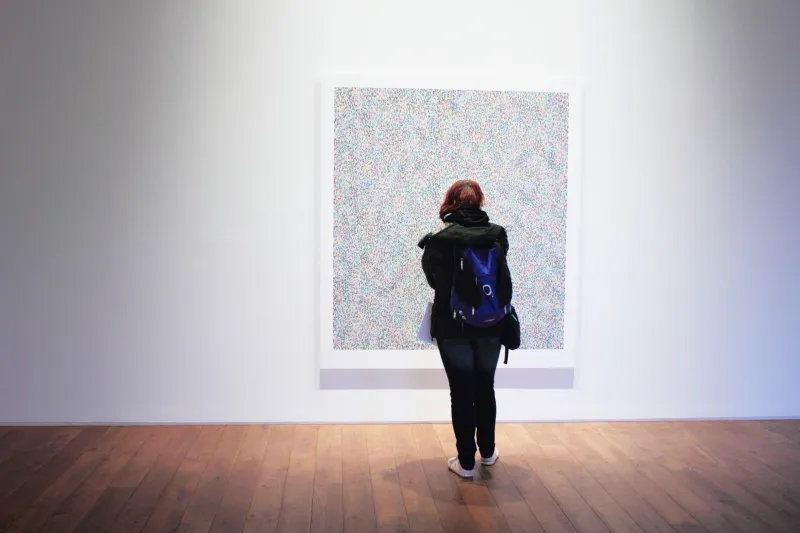
There is a particular kind of discomfort that descends upon people standing in front of a Mark Rothko painting for the first time. They wait, instinctively, for something to happen—for the canvas to deliver a message, resolve a tension, or at minimum explain itself. It does none of these things. It simply persists, luminous and indifferent, asking nothing and answering less. For many visitors, this is quietly maddening. For others, it is among the most profound experiences a cultural institution can offer. The distinction between those two reactions reveals something essential about the relationship between art and the age we currently inhabit.
We live, at present, in a civilization organized around the premise that every problem deserves a solution, every inefficiency a correction, and every question an answer that can be measured, replicated, and scaled. Silicon Valley evangelizes this worldview with particular fervor, but it has colonized far broader territory—education policy, healthcare delivery, urban planning, even personal relationships are now routinely subjected to optimization frameworks. Science, at its most applied, is the engine of this paradigm: rigorous, replicable, relentlessly purposeful. And into this landscape, art arrives like a magnificent act of refusal.
The Philosophical Provocation of Uselessness
When Marcel Duchamp submitted a commercially purchased urinal to the Society of Independent Artists exhibition in 1917, he was not making a statement about plumbing. He was conducting a philosophical experiment with no hypothesis and no expected outcome—which is precisely what made it so destabilizing. Fountain did not solve anything. It did not improve anything. It existed purely to generate a question that could not be cleanly answered: what, exactly, is art, and who has the authority to say so? More than a century later, that question remains productively unresolved, and the work's power derives entirely from that irresolution.
This is not coincidental. The history of avant-garde art is, in many respects, a sustained argument against utility. The Dadaists dismantled logical coherence as a form of protest against a civilization that had used rational planning to industrialize mass slaughter in the trenches of World War I. The Abstract Expressionists rejected narrative legibility in favor of pure emotional transmission—or something even less definable than that. Agnes Martin spent decades producing near-monochromatic canvases of hand-drawn grids that she described not as minimalism but as expressions of happiness, innocence, and the sublime. None of these artists were failing to communicate clearly. They were arguing, through practice, that clarity itself was an inadequate ambition.
What Science Cannot Do
It would be a misrepresentation to suggest that science is indifferent to beauty or incapable of wonder. Einstein himself famously described his general theory of relativity in aesthetic terms, and the history of mathematics is populated with researchers who pursued elegant proofs with something very close to artistic motivation. The natural world, as science reveals it, is staggeringly beautiful—from the geometric precision of crystalline structures to the recursive complexity of galactic formation.
But science's beauty is always, ultimately, in service of something else. An elegant equation earns its elegance by being correct. A beautiful experimental design is beautiful because it isolates variables with precision. The aesthetic dimension of scientific work is real, but it is instrumental—a quality that emerges from rigor rather than one that exists independently of it. Science cannot, by its own methodology, produce an experience whose value lies entirely in its resistance to resolution. That territory belongs exclusively to art.
This is not a limitation of science. It is simply a description of its nature. The two disciplines are not competing; they are operating in genuinely different registers of human experience. What becomes problematic is when the logic of one domain is imported wholesale into the other—when we begin asking art to justify itself in the language of outcomes, impact metrics, and measurable cognitive benefit.
The Productive Power of Ambiguity
Contemporary artists who work most deliberately with ambiguity are, in a sense, practicing a form of intellectual judo. By refusing to resolve, they force the viewer into an active relationship with meaning-making. The artist Kara Walker constructs monumental silhouette installations that address the history of American slavery with an imagery so simultaneously beautiful and horrifying that no single emotional or intellectual response can contain them. The discomfort is not incidental—it is the mechanism. The work does not tell you what to think. It creates conditions in which thinking becomes unavoidable.
Similarly, the late sculptor Louise Bourgeois produced work that drew on personal trauma, psychoanalytic symbolism, and formal abstraction in ways that defied stable interpretation across a career spanning seven decades. Her famous spider sculptures—monumental, maternal, threatening—have generated an enormous body of critical literature that has not, and cannot, arrive at a definitive reading. This is their gift. They remain alive precisely because they remain open.
In cognitive terms, this openness may be doing something quite specific. Research in psychology suggests that states of productive uncertainty—what some researchers call epistemic curiosity—are associated with heightened attention, deeper memory encoding, and more flexible thinking. Art that refuses easy resolution may, in other words, be training the mind in ways that optimization-oriented experiences cannot. The purposeless thing turns out to have a purpose after all, though one that cannot be captured in a quarterly report.
Permission to Not Know
Perhaps the most culturally significant function that art performs in the present moment is one of simple permission. In a society that pathologizes uncertainty and rewards the confident assertion of answers, art offers a space in which not knowing is not only acceptable but actively valued. Standing before a painting that refuses to explain itself, a viewer is granted, however briefly, release from the obligation to have a take.
This is not escapism. It is, arguably, a form of cognitive hygiene—a regular reminder that the most important aspects of human experience routinely exceed the frameworks we build to contain them. Love, grief, moral complexity, the passage of time: none of these submit gracefully to optimization. Art does not solve them either, but it sits with them honestly, and in doing so, it models a relationship with uncertainty that may be among the most valuable things one mind can demonstrate to another.
Einstein once observed that imagination is more important than knowledge—that knowledge is limited while imagination encircles the world. He was, in his way, describing the territory that art inhabits: the space beyond what can be proven, measured, or solved. That space is not empty. It is, in fact, where much of what makes us human resides. Art's refusal to fill it with answers is not a failure of ambition. It is an act of extraordinary intellectual honesty.