Signal Without Warmth: How Digital-Age Artists Are Mapping the Geometry of Human Isolation
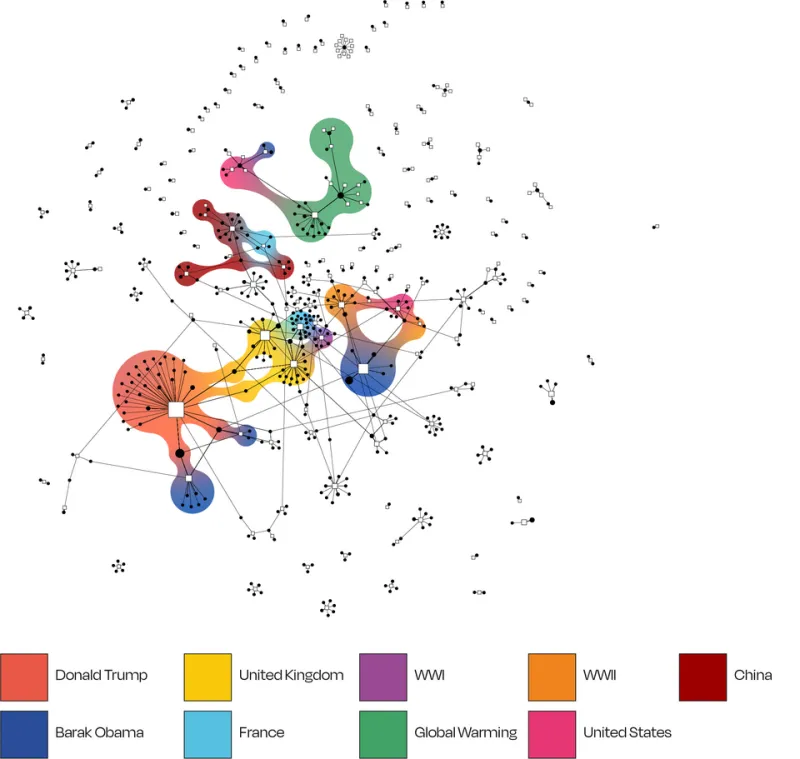
Photo: Ecpp, CC BY-SA 4.0, via Wikimedia Commons
There is a particular cruelty embedded in the architecture of modern social life. We inhabit platforms engineered to maximize connection — algorithmically curated, perpetually optimized, relentlessly present — and yet the surgeon general of the United States has, in recent years, declared loneliness a public health epidemic. The data and the lived experience are in open contradiction. Artists, characteristically, have noticed.
Across studios in Brooklyn, Los Angeles, and Chicago, a growing cohort of contemporary practitioners is doing something unexpected with the language of network theory and data visualization. They are not using it to celebrate connectivity. They are using it to anatomize its collapse.
The Aesthetics of the Empty Node
In graph theory, a node with no edges — no connections radiating outward — is called an isolate. It exists within the network's coordinate space but participates in nothing. Several artists working at the intersection of computational design and social critique have seized on this image as a kind of contemporary emblem.
Consider the broader movement of artists who render social graph data — the kind harvested from platforms like Instagram or X — as large-scale prints or luminous installations. When a viewer stands before a visualization of their own social network, the eye is naturally drawn not to the densely woven center but to the periphery: the pale, attenuated threads, the nodes that appear once and then dissolve. The loneliness is not announced. It is geometric.
This is a fundamentally different emotional register than, say, Edward Hopper's diner counter or the alienated figures of Eric Fischl's suburban tableaux. Those works invited identification through representation. The data-driven works invite something stranger — a recognition that is almost clinical before it becomes personal. You see the shape of disconnection before you feel it.
Metrics as Material
The UCLA Loneliness Scale, developed by social psychologist Daniel Russell in the late 1970s, remains one of the most widely used instruments for measuring subjective social isolation. It asks respondents twenty questions about the frequency with which they feel understood, left out, or companionable. The result is a number. A score.
Some artists have taken that score literally — treating loneliness metrics as raw sculptural or compositional material in the same spirit that a painter might treat pigment. The resulting works occupy an uncomfortable middle territory between infographic and elegy. They are legible and illegible simultaneously. The data is present, traceable, even citable. But the experience of standing before it — before a room-scale rendering of aggregated loneliness scores from a mid-sized American city — is not the experience of reading a chart. It is something considerably more unsettling.
What these artists understand, intuitively or by design, is that data stripped of its spreadsheet context does not become less emotional. It becomes more so. The abstraction, paradoxically, restores the human weight that the measurement process had temporarily suspended.
Einstein's Entanglement, Picasso's Fragmentation
There is a useful analogy lurking in the site's own intellectual inheritance. Einstein devoted considerable energy to what he called the problem of locality — the question of whether distant particles could influence one another without any visible mechanism of transmission. Picasso, working in roughly the same historical moment, was busy dismantling the idea that a face could be rendered from a single, stable point of view. Both were grappling, in their respective disciplines, with the failure of conventional frameworks to account for the full complexity of relational experience.
The artists mapping digital loneliness are engaged in something structurally similar. The conventional framework — the social network, the friend count, the engagement metric — purports to describe human connection in full. These artists are insisting that it describes only a projection. The full dimensionality of isolation, like the full dimensionality of a Cubist portrait, requires a different kind of seeing.
Can Algorithmic Art Generate Empathy?
The more provocative question embedded in this body of work is whether art made from the instruments of disconnection can actually reconnect. This is not merely rhetorical. There is genuine debate among critics and cognitive scientists about whether data visualization, however aestheticized, can produce the kind of empathic response that figurative or narrative art reliably generates.
The argument against is intuitive: empathy requires a face, a story, a particular human being whose interior life becomes momentarily accessible. A network graph, however elegantly rendered, offers none of these. It is a structure, not a person.
The argument for is subtler and, in some ways, more interesting. When a viewer encounters a data-driven installation about loneliness and recognizes — not intellectually but viscerally — that the shape on the wall resembles something in their own life, something the artist could not possibly have known about them, a different kind of empathy is activated. Not identification with a represented other, but recognition of a shared condition. The work does not say: here is someone lonely. It says: here is the shape that loneliness takes. And the viewer supplies the rest.
This is, arguably, what the best art has always done. It provides the geometry. We provide the grief.
The Deeper Irony
There is one final irony worth sitting with. The platforms that have generated the loneliness epidemic have also generated the data that artists are now using to document it. The surveillance apparatus of social media — the engagement tracking, the behavioral modeling, the social graph mapping — has inadvertently produced an archive of human disconnection at a scale no previous era could have assembled.
Artists are raiding that archive. They are making it strange and slow and beautiful, in the way that art makes things strange and slow and beautiful. Whether the resulting works constitute a critique of the platforms, a lament for the connections those platforms promised and failed to deliver, or simply a new aesthetic vocabulary for an old human ache is, perhaps, a question each viewer must answer alone.
Which is, of course, the point.