Chaos by Design: How Controlled Randomness Became the Secret Language of Beauty
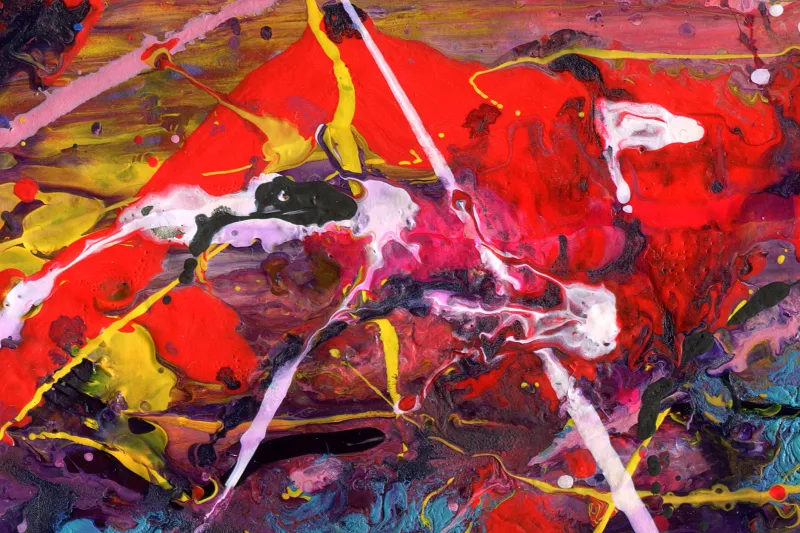
There is a particular kind of beauty that unsettles us precisely because we cannot locate its author. It lives in the branching of frost across a windowpane, in the irregular percussion of rain against pavement, in the dripped and flung lacework of paint that Jackson Pollock unleashed onto canvas in his Springs, New York studio during the late 1940s. We respond to it viscerally, often before we can articulate why. And increasingly, researchers working at the intersection of cognitive neuroscience, mathematics, and art history are converging on a remarkable explanation: the human aesthetic response may be, in fundamental ways, a sensitivity detector for a very specific class of mathematical disorder.
Not chaos in the colloquial sense. Something far more precise — and far more strange.
The Mathematics Hidden Inside the Mess
When physicist Richard Taylor of the University of Oregon began analyzing Pollock's drip paintings in the late 1990s, he was not looking for beauty. He was looking for fractal dimension — a mathematical measure of how complexity scales across different levels of magnification. What he found reoriented the conversation about abstract expressionism entirely. Pollock's canvases, Taylor determined, exhibited fractal patterns consistent with those found throughout the natural world: in coastlines, tree canopies, and cloud formations. The fractal dimension of Pollock's work increased over the course of his career, trending toward values that Taylor's subsequent human-subject studies identified as the range most people find aesthetically pleasing.
The implication was difficult to dismiss: Pollock, whether consciously or not, had calibrated his randomness. He had not simply flung paint. He had, through years of physical practice and perceptual refinement, trained his body to generate controlled stochastic processes — probabilistic outputs that landed, repeatedly, within a mathematically defined zone of visual comfort.
This is the paradox at the heart of the matter. True randomness, in the statistical sense, tends to produce results we find ugly or incoherent — a canvas splattered with a random number generator feels lifeless, even oppressive. What we find beautiful is not randomness itself but structured randomness: variation constrained by underlying rules, disorder operating within a probabilistic envelope. Scientists call these processes stochastic. Artists, for centuries before the terminology existed, have been generating them intuitively.
Why the Brain Prefers the Probable
The neurological argument for why this might be so draws on predictive processing theory, a framework that has gained considerable traction in cognitive science over the past two decades. In this model, the brain is less a passive receiver of sensory information than a relentless prediction engine, constantly generating hypotheses about the world and updating them against incoming data. Aesthetic pleasure, under this account, arises from a particular ratio of prediction and surprise — what researchers sometimes describe as the sweet spot between boredom and anxiety.
Purely ordered patterns — a grid, a repeating tile — are too easily predicted. The brain exhausts its interest almost immediately. Purely chaotic patterns offer no foothold for prediction at all, generating a kind of cognitive static that most people experience as unpleasant. But probabilistic patterns, those that follow detectable statistical rules while remaining locally unpredictable, keep the predictive system perpetually, pleasurably engaged. The brain senses the underlying structure, makes predictions, encounters variation, revises, predicts again. The loop sustains attention. It generates what we call wonder.
This may explain why so many of the natural phenomena we find beautiful — the murmuration of starlings, the veining of a marble slab, the irregular rhythm of ocean waves — are, on examination, stochastic processes governed by relatively simple probabilistic rules. Evolution, it seems, may have tuned human perception to find the signature of these processes rewarding, because environments exhibiting such patterns — forests, water sources, varied terrain — were historically the ones most likely to sustain life.
Artists Who Knew Before the Science Did
Pollock is perhaps the most celebrated example, but he is hardly alone. The Japanese aesthetic concept of wabi-sabi, which prizes asymmetry, impermanence, and the beauty of imperfection, can be understood as a cultural codification of stochastic appreciation. The hand-thrown ceramic that bears the mark of its making, the raked gravel garden whose lines are never quite parallel — these are not accidents but engineered probabilities, forms shaped to fall within the perceptual range where beauty lives.
More recently, generative artists working with algorithmic tools have made stochastic processes central to their practice in an entirely explicit way. Artists such as Tyler Hobbs, whose Fidenza series used flow-field algorithms to produce works that feel simultaneously organic and computational, or the late Vera Molnár, who spent decades exploring the aesthetic consequences of controlled algorithmic deviation, have essentially built probability engines and asked audiences to find meaning in their outputs. The response, particularly within the NFT art market of the early 2020s, suggested that audiences were more than willing to do so — often passionately.
What these artists share with Pollock, and with the anonymous craftspeople behind centuries of Islamic geometric tilework or Native American weaving traditions, is an understanding that the artist's role is not always to impose order but sometimes to govern disorder — to set the probabilistic boundaries within which beauty can emerge on its own terms.
The Uncomfortable Question This Raises
If beauty is, at least partially, a response to stochastic patterns that fall within a neurologically preferred range, then several assumptions we hold about artistic genius become considerably more complicated. Is the artist's skill, in some meaningful sense, a skill of probabilistic calibration? Does creative mastery involve learning, over years of practice, to generate outputs whose statistical properties align with perceptual sweet spots — not through calculation but through embodied, intuitive refinement?
And if so, what does it mean that generative algorithms can now be tuned to produce work within those same statistical ranges? Is the output beautiful? Many people, encountering such work without knowing its origin, say yes. Does that answer matter?
These questions do not resolve neatly, and perhaps they should not. The history of both art and science is littered with the wreckage of premature certainties. What the convergence of stochastic mathematics and aesthetic theory offers is not a formula for beauty but something more valuable: a deepened sense of how strange and specific the human response to the world actually is.
The Edge Where Order Dissolves
Picasso once remarked that the purpose of art was to wash the dust of daily life from the soul. Einstein, for his part, described the experience of scientific insight as a kind of aesthetic shock — the sudden recognition of an underlying order that had previously been invisible. Both descriptions, read through the lens of stochastic aesthetics, point toward the same territory: the place where structure and surprise meet, where the predictable gives way to the merely probable.
That edge — the boundary between order and its dissolution — may be where beauty has always lived. The mathematics is new. The sensation is ancient. And the conversation between the two, which artists and scientists are only beginning to conduct in earnest, promises to be one of the more illuminating of our time.