The Unseen Made Visible: How Scientific Imaging Rewired the Modern Artistic Eye
For most of human history, artists worked with what the naked eye could offer: the play of light on water, the architecture of the human form, the geometry of landscape. The visible world was, by definition, the world. Then, incrementally and then all at once, science began dismantling that boundary.
Today, a painter in a Brooklyn studio can scroll through NASA's image archive and study the gaseous pillars of the Eagle Nebula in saturated detail. A sculptor in Los Angeles can reference electron microscope imagery of diatom shells—microscopic algae whose geometric precision rivals any human-designed lattice. A digital artist in Chicago can pull particle collision visualizations from CERN's public data repository and find in them a kinetic beauty that no prior century of artists could have imagined, because no prior century knew such images existed.
The visual vocabulary of art has been permanently enlarged. The question worth asking is what, exactly, that enlargement means.
A New Palette From the Laboratory
The relationship between scientific instrumentation and artistic vision is older than it might appear. When Antonie van Leeuwenhoek turned his early microscope on pond water in the 1670s and discovered a teeming invisible world, he was also, inadvertently, creating a new category of the visually sublime. The revelation that the apparently empty and inert was actually dense with form and motion did not stay confined to scientific journals. It leaked into the cultural imagination and began, slowly, to reshape what artists understood reality to contain.
The 20th century accelerated this process dramatically. X-ray crystallography—the same technique that produced Rosalind Franklin's famous Photo 51 image of DNA—revealed molecular structures of such austere geometric elegance that they influenced a generation of designers and architects. Buckminster Fuller's geodesic domes owe a philosophical debt to the structural logic that crystallography exposed. The modernist preoccupation with pure form, stripped of ornament, found unexpected validation in the molecular world's preference for efficiency and symmetry.
Thermal imaging arrived in the mid-20th century and introduced artists to a parallel reality overlaid on the familiar one—a world defined not by reflected light but by heat signatures, where human bodies glow like lanterns and cold objects recede into deep blue silence. Photographers and installation artists seized on thermal imagery's capacity to defamiliarize the ordinary, to make a crowd of commuters look like a celestial event.
Case Studies in Scientific Vision
The influence is not abstract. Specific artists have drawn directly and explicitly from the well of scientific visualization.
Lisa Nilsson, a Massachusetts-based artist, creates cross-sectional anatomical images using the Japanese paper-rolling technique of quilling. Her work is inseparable from the tradition of medical imaging; she cites MRI scans and anatomical atlases as primary visual sources. The result is art that is simultaneously scientifically informed and unmistakably handcrafted—a deliberate dialogue between the precision of the instrument and the imprecision of the human hand.
The late American artist Charles Ross spent decades creating Star Axis, a naked-eye observatory built into the desert of New Mexico that aligns with the Earth's axis and tracks the motion of stars over a 26,000-year precession cycle. Ross's project is impossible to categorize as purely art or purely science; it is a physical structure designed to make cosmic time perceptible to a human body standing inside it. The imaging technology here is architectural—the building itself is the instrument.
More recently, the visualizations produced by the Event Horizon Telescope collaboration—the 2019 image of the black hole at the center of galaxy M87—generated immediate and widespread aesthetic response. Within hours of publication, the image appeared in design blogs, art forums, and social media feeds not as a scientific document but as a visual object of considerable power: a luminous ring of orange and gold surrounding an absence. Several artists have since produced work directly referencing or responding to that image, treating it as one might treat a Rembrandt—as a composition worthy of study and dialogue.
Seeing What Isn't There
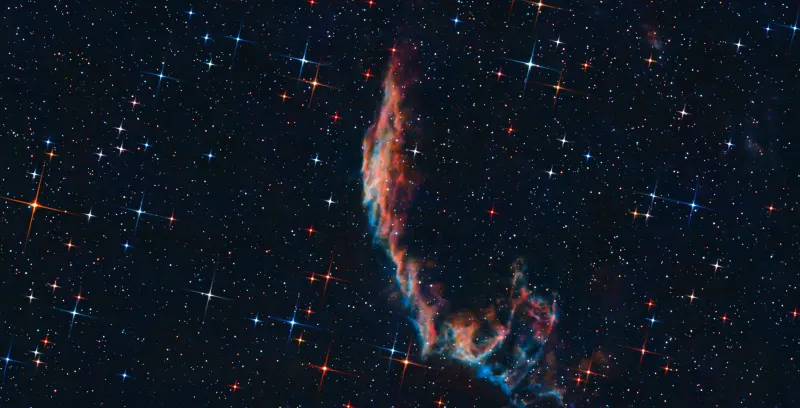
There is a philosophical complication lurking inside all of this, and it deserves honest attention. Scientific visualizations are not photographs in the conventional sense. The Hubble images that have become cultural touchstones are false-color composites—infrared and ultraviolet data translated into visible wavelengths and assigned colors that are, in a meaningful sense, editorial choices. The orange of a nebula is not the orange that would greet your eye if you were somehow present in space nearby. It is a rendering, a translation, an interpretation.
This does not diminish the images. It complicates them in ways that are genuinely interesting. Every scientific visualization involves decisions—about color mapping, contrast, scale, framing—that are aesthetic as well as informational. The scientists who process Hubble's raw data are, whether they frame it this way or not, making visual art. The boundary between discovery and representation blurs in ways that should fascinate anyone interested in either science or aesthetics.
For artists working with these images as source material, this layer of mediation adds rather than subtracts meaning. The work becomes a conversation not just between art and science but between multiple acts of translation—from phenomenon to data to visualization to artistic interpretation. Each step introduces human judgment, and each step is therefore culturally and historically situated.
A Reshaped Aesthetic Sensibility
What emerges from all of this, surveying 21st-century art with attention to scientific influence, is something that might be called an aesthetic of the revealed. Contemporary artists and audiences have developed a taste for images that carry the charge of genuine discovery—that feel as though they are showing us something that was always there but previously hidden. The popularity of macro photography, data visualization as art form, and the widespread cultural appetite for imagery from space missions all reflect a sensibility shaped by decades of scientific imaging expanding what counts as seeable.
This is, in its way, a profound shift. For centuries, Western aesthetic tradition privileged the human scale—the landscape as experienced from a hillside, the face as encountered across a room. Scientific imaging has introduced scales both vastly larger and incomprehensibly smaller than human experience, and contemporary artists have absorbed those scales into their sense of what beauty can look like.
Einstein once remarked that imagination is more important than knowledge. The great irony of scientific imaging is that it has made the two inseparable. Every image produced by an instrument peering beyond the range of human senses is simultaneously an act of knowing and an act of imagination—a decision about how to render the invisible legible, how to make the alien familiar, how to translate the language of the universe into something a human being can stand in front of and feel.
Artists have always been in that business. Science, it turns out, never left it.