Beyond the Eye: How Science's New Map of Perception Is Rewriting the Rules of Art

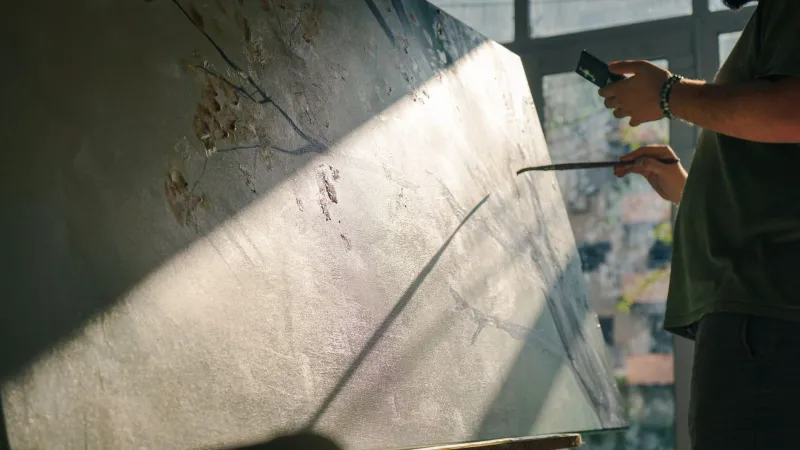
Photo: Yenais, CC BY-SA 4.0, via Wikimedia Commons
Walk into any major American art museum and you will encounter a set of instructions so thoroughly internalized that they no longer feel like instructions at all. Look. Do not touch. Maintain a respectful distance. Move quietly from object to object, absorbing through the eyes alone. The museum, as an institution, is a machine for producing a very specific kind of attention — one that privileges vision above every other sense and treats the body, from the neck down, as little more than a viewing platform.
This arrangement has a history, and like most histories, it is more contingent than it appears. The elevation of the visual as the sovereign sense in Western aesthetic experience is not a natural law. It is a cultural construction — one that is now, with remarkable speed, being undone by an unlikely alliance of neuroscientists and artists who are discovering, together, that the eye was never really in charge.
The Body Thinks
The concept of embodied cognition — the understanding that mental processes are not confined to the brain but are distributed throughout the body and shaped by physical interaction with the environment — has been building in cognitive science for roughly three decades. Its implications for aesthetics are only now being fully appreciated.
The traditional model of perception treated the brain as a kind of central processing unit: sensory data arrived from the periphery, was decoded in specialized cortical regions, and produced conscious experience. Under this model, vision was primary because it delivered the most information, most rapidly, from the greatest distance. It was the sense best suited to a disembodied intellect surveying the world from a safe remove.
The embodied cognition model tells a different story. Perception, researchers now understand, is not passive reception but active construction — the brain continuously generating predictions about the state of the world and updating them against incoming sensory data from multiple channels simultaneously. Crucially, those channels are not ranked. Touch, proprioception, interoception, smell, taste, and hearing are not degraded alternatives to vision; they are parallel streams that contribute, with roughly equal standing, to the unified experience of being in a body in a world.
Neuroscientist David Eagleman, whose work at Stanford has been widely discussed in both scientific and popular contexts, has demonstrated that the brain is far more plastic in its sensory processing than previously understood — capable of incorporating entirely novel sensory streams, including data from technological devices, into its perceptual model of the body and its environment. This is not a marginal finding. It is a fundamental revision of what perception means, and artists have been paying attention.
Haptic Frontiers
The most immediately visible consequence of this scientific shift in the art world has been an explosion of haptic practice — work designed to be apprehended through touch, pressure, vibration, and kinesthetic engagement rather than, or in addition to, visual observation.
Artists like Neri Oxman, whose work at the MIT Media Lab blurred the boundary between architecture, biology, and wearable sculpture, have built objects specifically engineered to communicate through tactile registers that vision cannot access. Her "Wanderers" series — wearable structures grown from biological materials — was designed to respond to the body's biochemical environment, creating an aesthetic experience that was literally incorporated into the wearer's physiology. The work was not completed by being looked at. It was completed by being worn.
In a different register, artists working in what is sometimes called "relational aesthetics" have developed performance and installation practices that require physical participation as their primary mode of engagement. Tino Sehgal's constructed situations — in which trained performers engage visitors in conversation, movement, or song without any fixed objects, documentation, or visual spectacle — strip away the visual entirely, leaving an experience that exists only in the body and in memory. The absence of the image is not a deprivation. It is the point.
Tasting the Work, Smelling the Century
Perhaps no development in contemporary art more directly challenges the visual hierarchy than the growing body of work that incorporates taste and smell — senses that Western aesthetics has traditionally excluded from serious consideration on the grounds that they are too subjective, too intimate, too animal.
The neuroscience of olfaction offers a compelling explanation for why these senses, when engaged in an artistic context, produce such unusually powerful responses. The olfactory bulb connects directly to the amygdala and hippocampus — the brain's centers for emotional processing and memory — without passing through the thalamic relay that filters most other sensory information. A smell reaches the emotional brain faster and more directly than a visual image. It bypasses the interpretive apparatus almost entirely.
Artists including Sissel Tolaas, a Norwegian smell researcher and artist based in Berlin whose work has been exhibited across the United States, have built entire bodies of work around this neurological shortcut. Tolaas has reconstructed historical smells — the olfactory environment of specific cities in specific decades, the chemical signature of fear and stress in human sweat — and presented them as primary aesthetic objects. The work operates on the viewer's nervous system before the viewer has had a chance to form an opinion about it.
Similarly, artists working in the emerging field of gustatory art — work that incorporates taste as a primary medium — are exploiting what neuroscientists call "crossmodal correspondence": the brain's tendency to automatically map qualities from one sensory domain onto another. Research has shown that the same wine is experienced as sweeter when consumed under red light, that music in a minor key makes food taste more bitter, and that the weight and texture of cutlery significantly alter the perceived flavor of what is eaten with it. These are not psychological curiosities. They are descriptions of how perception actually works — and artists are using them to construct experiences of remarkable precision and complexity.
Permission Slips from the Laboratory
What is perhaps most significant about this convergence of neuroscience and multisensory art practice is the way scientific findings have functioned as cultural permission — legitimizing experiments that the art world had long regarded with suspicion.
The prejudice against non-visual art forms in American cultural institutions has been substantial and durable. Haptic, olfactory, and gustatory work has historically been dismissed as gimmicky, insufficiently serious, or simply difficult to collect, preserve, and exhibit within existing institutional frameworks. The white cube of the gallery, like the museum before it, was designed for objects that could be looked at.
But as the scientific evidence for the primacy of multisensory experience accumulates — as embodied cognition moves from the margins of cognitive science to its mainstream — the cultural argument for privileging vision becomes progressively harder to sustain. If the brain does not, in fact, treat sight as the master sense, then the institutions built on that assumption are not neutral containers for aesthetic experience. They are arguments — specific, historically situated arguments — about what perception is and what art should do.
A New Aesthetic Contract
The artists working at this intersection are not simply making unusual objects. They are proposing a different relationship between artwork and audience — one in which the viewer's body is not a passive instrument of optical reception but an active participant whose full perceptual apparatus is engaged, challenged, and sometimes fundamentally reconfigured by the encounter.
This is, in the deepest sense, what the neuroscience demands: a recognition that aesthetic experience is not something that happens in the eyes or even in the brain, but something that happens in the whole organism, in real time, in response to a world that is far richer and stranger than any single sense can contain.
The eye, it turns out, was always just the beginning.